Life – Terror. Ecstasy. Fight. Denial. Flight. Failure. PAIN. Forgiveness. Reconciliation. Hope. Love. Peace.
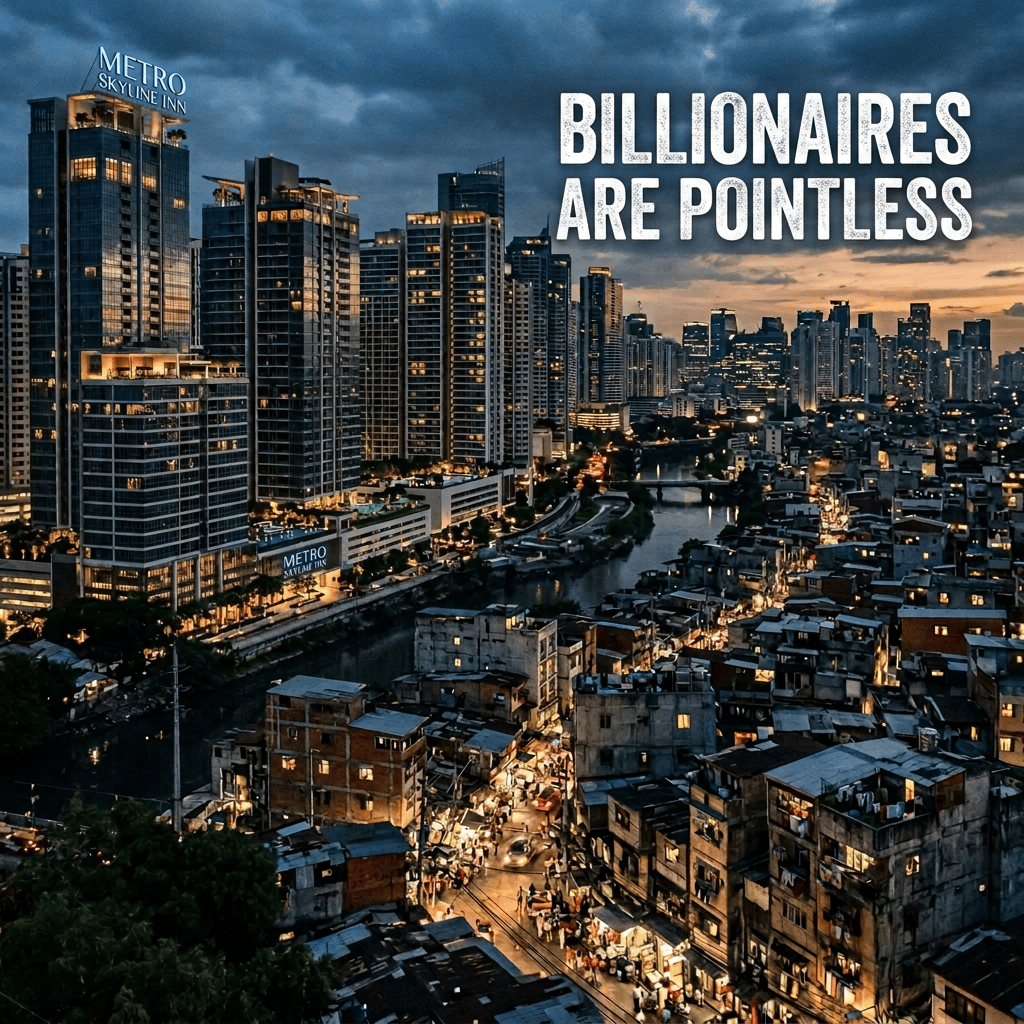
For me, by far, the weirdest thing 21st century society accepts as normal is the collective tolerance for infinite personal wealth accumulation while basic human needs go unmet globally. Why do we simply ‘accept’ Billionaires?
Society largely treats the existence of individuals holding tens of billions of dollars as a standard by-product of success, even though human psychology struggle to comprehend the sheer scale of a billion, and the math reveals it is an impossible amount for one person to spend in a single (multiple) lifetime.
The Illusion of Scale
- The Time Analogy: One million seconds is about 12 days. One billion seconds is roughly 32 years.
- The Spending Paradox: If you spent $10,000 every single day without earning another cent, it would take you over 273 years to spend just one billion dollars.
- The Hoarding Double Standard: If an individual hoarded millions of physical newspapers or water bottles in their yard while their neighbours starved, society would view it as a mental health crisis. When done with digital currency, it is celebrated as an achievement.
- Systemic Absurdities We Accept
- Tax Inversion: Accepting that billionaires often pay a lower effective tax rate than their administrative assistants by borrowing against their stock wealth (the “Buy, Borrow, Die” strategy) rather than taking a traditional salary.
- The “Self-Made” Myth: Attributing vast fortunes entirely to individual genius or “hard work,” while ignoring the massive public infrastructure, taxpayer-funded research, and thousands of underpaid workers that make the wealth possible.
Corporate Sovereignty: Allowing single individuals to hold more financial power and geopolitical influence than entire sovereign nations, effectively letting them dictate global space policy, communication networks, or public health initiatives.
- The Philanthropy Hall Pass: Praising billionaires for donating fractions of a percent of their net worth to charity, which often grants them massive tax write-offs and public relations shielding while letting them retain systemic control over where public resources go.
Financial loopholes billionaires use to avoid income tax
The core anomaly of modern billionaire wealth is the “Buy, Borrow, Die” strategy, which allows individuals to access billions in cash without ever triggering income tax.
“Buy, Borrow, Die”
In a standard economy, citizens pay income tax when they earn money. Billionaires bypass this system entirely by using a three-step financial loop:
- Buy (or Build): A founder builds a company. Their wealth is tied up in shares of stock, not cash. Because the stock price rises, their net worth grows by billions. Under current tax laws, unrealised capital gains are not taxed.
- Borrow: Instead of selling stock to buy mansions, yachts, or investments (which would trigger a capital gains tax), billionaires take out massive loans against their stock portfolios. Banks offer them ultra-low interest rates (often 1-2%). Because loan proceeds are not considered income, this cash is 100% tax-free.
- Die: When the billionaire passes away, their heirs receive the stock. The asset’s tax basis resets to its current market value (a loophole called the step-up in basis). The heirs can sell the stock to pay off the bank loans, and all the billions in growth over the lifetime escape income tax forever.
- Wealth Scaling: Billionaires vs. Average Workers
- The gap between a billionaire’s financial velocity and an average worker’s reality defies human intuition.
- The Hourly Disconnect: If an average worker earns £25 per hour, they would need to work full-time for 20,000 years without spending a single penny just to accumulate £1 billion.
- The “Penny” Comparison: To a person worth £100 billion, spending £1 million feels economically identical to an average middle-class person spending £1.
- Passive Generation: A £50 billion fortune invested conservatively at a 5% annual return generates £2.5 billion per year in pure interest. That is roughly £285,000 every single hour, day and night, completely independent of labour.
The Psychological Impact: The Empathy Gap
Psychological research into extreme wealth reveals that holding vast financial power alters human behaviour in predictable, often unsettling ways:
- Decreased Social Attunement: Studies consistently show that wealthier individuals are less adept at reading the emotions of others and less likely to exhibit compassion. When you do not rely on a community for survival, your brain stops prioritising social cooperation.
- The Entitlement Illusion: Wealth creates a psychological buffer that shields individuals from negative feedback. Over time, this breeds an assumption that success is purely the result of superior genetics, intelligence, or effort, rather than systemic advantages or luck.
- Risk Insulation: Because no financial mistake can result in ruin, the wealthy develop a detached relationship with real-world consequences. This explains why billionaire-backed projects often focus on speculative, high-concept ideas (like colonising Mars) rather than solving immediate, earthly infrastructure crises.
- The shift from traditional capitalism to a system dominated by billionaires is giving rise to entirely new social structures that rewrite how the world functions.
- The Rise of “Techno-Feudalism”
- Economists like Yanis Varoufakis argue that we are moving past standard capitalism into a system resembling feudalism, where tech billionaires act as medieval lords. [1, 2]
- Cloud Fiefdoms: Instead of competing in traditional physical marketplaces, commerce now relies entirely on digital platforms (like Amazon or Apple’s App Store). These platforms operate like private fiefdoms. If you want to sell a product, you must pay a “cloud rent” (frequently a 15–30% cut) to the platform owner just to exist in their space. [1, 2, 3]
- Algorithmic Serfdom: Under traditional capitalism, workers sell their labour for wages. In the digital economy, billions of people act as “cloud serfs”. Every time you post a video, leave a review, or scroll through a feed, you train an algorithm for free. This unpaid data generation directly multiplies the platform owner’s multibillion-dollar asset value. [1, 2, 3]
- The Death of Choice: Markets used to operate on supply and demand. Now, AI-driven feeds manufacture your desires. The algorithm isolates you in a personalised bubble, decides what information you see, and subtly nudges your spending habits, stripping away true consumer agency. [1]
- The “Billionaire Tax” Battleground
- As public sentiment shifts—with a significant majority of adults across G20 nations agreeing that the ultra-wealthy are taxed too little — governments are attempting to crack down. However, fixing these loopholes proves incredibly difficult: [1, 2]
- The G20 Minimum Floor: International proposals focus on creating a global minimum wealth tax floor (targeting a 2% minimum effective rate for the world’s ~3,000 billionaires). If a billionaire structures their finances to pay 0% income tax, a top-up tax would automatically trigger. [1, 2]
- The Capital Flight Threat: The primary barrier to passing these laws is “capital strike.” When local jurisdictions attempt aggressive measures—like California’s proposed wealth taxes—critics and investors warn it will trigger massive wealth flight. Because digital assets can be moved to a tax haven with a keystroke [physical assets – houses/property cannot], independent countries fear that taxing billionaires will simply force innovators and capital to leave. [1, 2, 3]
- The “Paper-Rich” Problem: Many startup founders are asset-rich but cash-poor. Forcing them to pay a percentage of their net worth every year means they would be legally required to sell off chunks of their own companies just to pay the tax bill. This could destabilise corporate ownership and punish creators before their ideas turn a real profit. [1]
The Geopolitical Shift
Ultimately, society has normalised a reality where a handful of unelected individuals wield more power than sovereign states. When a single billionaire can single-handedly control global satellite internet over a war zone, dictate the terms of public digital discourse, or fund public health initiatives that steer global policy, the concept of democratic accountability shifts entirely.
Philanthropy as a Weapon for Tax Avoidance and Political Influence
Modern elite philanthropy is rarely a purely selfless act. It frequently functions as a highly sophisticated mechanism to convert tax liabilities into private, tax-free political and social leverage.
The Tax Avoidance Playbook
- The Charitable Contribution Loophole: High-net-worth individuals donate highly appreciated assets (like stock) to private foundations. They receive an immediate income tax deduction for the full market value of the stock, while entirely avoiding the capital gains tax they would have owed if they sold it.
- Donor-Advised Funds (DAFs): Wealthy donors place millions into DAFs to claim an instant, massive tax write-off. However, the law does not require DAFs to distribute that money to actual working charities on any specific timeline. The funds can sit in investment accounts for decades, generating fees for Wall Street managers while remaining completely tax-shielded.
- The 5% Minimum Distribution Trick: Private foundations are legally required to pay out only 5% of their endowment assets each year to maintain their tax-exempt status. Crucially, foundations can count their own internal administrative expenses—including six-figure salaries for family board members, luxury travel, and “educational” galas—toward that 5% quota.
The Political Influence Machine
- Buying Policy Priorities: Massive foundations operate like parallel, unelected governments. By funding specific scientific research, educational programs, or public health initiatives, a billionaire can dictate global public policy agendas without ever facing a voter.
- Dark Money Routing: Wealthy individuals routinely use tax-exempt social welfare organisations (501(c)(4) groups in the US, or registered educational trusts elsewhere) to fund political attack ads and lobby for deregulation. Because these entities are structured as non-profits, the donors remain completely anonymous while writing off the influence campaign as a charitable endeavour.
- Reputational Washing: Philanthropy buys social license. Donating a fraction of a percent of a fortune to a prestigious university or museum allows a billionaire to reshape their public narrative, distracting from exploitative labour practices, environmental damage, or antitrust violations.
- A small group of wealthy individuals and billionaires hold a massive ownership stake in major traditional media, social networks, and digital platforms, giving them significant influence over the global information landscape. While they do not have total control over every piece of news, their vast ownership shapes what stories get told and how people consume information. [1, 2]
Jeff Bezos owns The Washington Post.
The Murdoch family runs Fox News and News Corp. controlling numerous newspapers globally.
The Ellison family controls Paramount Skydance, which includes CBS.
According to reports compiled by Forbes, a small circle of billionaires owns the vast majority of major American news organisations. These 15 Billionaires Own America’s News Media Companies
Social Media and Digital Platforms – Control has also shifted heavily toward digital infrastructure and social networks:
Elon Musk owns X (formerly Twitter).
Mark Zuckerberg oversees Meta, whose platforms reach billions of people and dictate major distribution algorithms for online content.
Research indicates that a small number of tech billionaires control nearly all of the world’s most popular social media apps and dominant AI chatbot markets. [1, 2, 3, 4]
Why It Matters
Concentrated ownership creates distinct effects on public discourse:
- Narrative Shaping: Owners can influence editorial priorities, suppress certain topics, or promote specific political and economic viewpoints. [1, 2]
- Gatekeeping: Tech platforms can block or restrict news content during political disputes over regulations and payments to publishers. [1]
- Public Perception: As traditional TV and print media decline in favour of algorithms and social feeds, the personal choices of a few tech owners carry greater weight in directing global conversations. [1]
No single person or entity controls billionaires. Instead, billionaires operate within an exclusive, complex web of legal frameworks, market forces, state authorities, and public pressures that limit and direct their actions.
Billionaires do not operate in a vacuum; their wealth is highly dependent on external financial systems.
- Institutional Investors: Most billionaire wealth is tied up in corporate stock. Institutional asset managers like BlackRock, Vanguard, and State Street manage trillions of dollars and hold massive voting power in public companies, frequently forcing billionaire founders to align with shareholder demands.
- Boards of Directors: Publicly traded companies are legally governed by a Board of Directors. Boards have the fiduciary duty to protect shareholders and possess the corporate authority to oust billionaire executives or founders if they mismanage the business.
- The Valuation Illusion: A billionaire’s net worth fluctuates wildly based on public market sentiment. If the public loses trust in a product or brand, market valuations collapse, erasing billions of dollars in personal wealth overnight.
The phrase “The New World Order” is understood in two entirely different ways: as a legitimate historical term in international politics and as a widespread conspiracy theory.
The Conspiracy Theories: A Secret Elite
In popular culture and internet subcultures, the phrase refers to a conspiracy theory claiming that a secret, authoritarian global government is actively working to eliminate national sovereignty and rule the world.
- The Alleged Control: The theory claims that a shadow group of international billionaires, political leaders, and secretive organisations (like the Illuminati, the World Economic Forum, or the Bilderberg Group) orchestrate global crises—like economic recessions, pandemics, or wars—to gain total control over humanity.
- The Reality: While global organisations like the World Economic Forum do bring billionaires and politicians together to discuss policy, these groups do not have the legal authority to dictate laws to sovereign nations. Rather than operating as a unified, secret group, global billionaires, corporations, and governments are frequently locked in fierce competition, legal disputes, and conflicting national interests.
Why These Theories Persists
The conspiracy theory remains highly popular because it offers a simple, singular explanation for highly complex global events. When the global economy is unstable, or when rapid technological advancements occur, attributing these shifting forces to a hidden group of powerful individuals provides an easy-to-understand narrative for systemic problems.
The Facts: What is Real?
- Extreme Wealth Concentration: A tiny fraction of the global population owns a massive percentage of the world’s wealth. These individuals have outsized access to political leaders, major media outlets, and global platforms.
- Global Networks: Organisations like the World Economic Forum (WEF) or the Council on Foreign Relations do exist, and they bring billionaires, corporate CEOs, and politicians together behind closed doors to discuss global policies, economics, and technology.
- Corporate Lobbying: Wealthy individuals and massive corporations spend billions of dollars annually to lobby governments, shape tax laws, and influence regulations to favour their business interests.
- A 19th-Century Financial Powerhouse: Founded by Mayer Amschel Rothschild in the late 1700s in Frankfurt, the family established a highly successful banking network across five European cities (London, Paris, Frankfurt, Vienna, and Naples).
- Financing Nations: During the 1800s, the Rothschild banks were instrumental in financing governments, building Europe’s early railway networks, and funding military campaigns, including Great Britain’s efforts in the Napoleonic Wars.
- Modern Wealth Dispersion: Over the last 150 years, the family’s immense wealth has been divided among hundreds of descendants, diluted through taxes, and split into various independent corporate entities and charities. While some family members remain wealthy and work in private banking, asset management, or wine production (such as the firms Rothschild & Co and Edmond de Rothschild Group), their combined wealth is a fraction of the trillions owned by modern institutional mega-funds or tech billionaires.
- Ownership of Central Banks: A widespread myth claims the Rothschilds own the US Federal Reserve or control all the world’s central banks. In reality, the Federal Reserve is an independent government agency overseen by Congress, and its member commercial banks do not “own” it or make profits from public policy.
- A Hidden Shadow Empire: Conspiracy theories often position the family as the secret puppet masters behind global wars, economic crashes, and political elections. These claims are entirely unproven and ignore the actual, transparent forces that drive the global economy, such as central bank interest rate policies, sovereign government laws, and massive publicly traded investment corporations.
- Antisemitic Roots: Most modern conspiracy theories surrounding the Rothschild family are built upon centuries-old antisemitic tropes. Historically, when people could not easily understand complex global banking systems, scapegoating a prominent Jewish banking family became an easy way to spread political propaganda.
The Rothschilds were once the most powerful bankers in the world, but their era of dominance peak occurred in the 1800s. Today, global financial power is held by massive public corporations, sovereign states, central banking committees, and new tech billionaires—arguably, not a single family lineage.
Global Capital and Asset Managers
While politicians pass laws, global financial institutions dictate where money flows. Real economic power today belongs to institutional asset managers rather than individual billionaires:
- The “Big Three” Asset Managers: BlackRock, Vanguard, and State Street collectively manage tens of trillions of dollars. They are the largest shareholders in almost every major publicly traded corporation in the world, giving them immense, quiet leverage over global industry, energy, and housing.
- Central Banks: Institutions like the US Federal Reserve or the European Central Bank hold incredible power over the global economy. By raising or lowering interest rates, a small committee of economists can trigger recessions, curb inflation, or shift trillions of dollars across borders overnight.
The Digital Infrastructure (Big Tech)
Over the last two decades, a new layer of global rule has emerged: the corporate entities that control the flow of human information and digital infrastructure.
- Information Gatekeepers: Companies like Alphabet (Google), Meta, and Apple control the algorithms that dictate what billions of people see, think, and buy every day.
- The Physical Internet: Cloud computing monopolies like Amazon Web Services (AWS) and Microsoft Azure host a massive portion of the world’s data, healthcare systems, and corporate infrastructure. If their servers go down, parts of the global economy grind to a halt.
A Balanced Perspective?
If you look closely at global events, you will see these three forces constantly fighting each other. For example, a tech billionaire might own a massive platform, but a sovereign government can fine them billions or ban their app entirely. A government might want to fund a public project, but global bond markets can crash their currency if investors lose confidence.
The world is not ruled by a hidden room of elites; it is ruled by elite, complex, competing systems?
They do not need to rule through a secret, coordinated shadow government, global elites hold exceptional, disproportionate influence that shapes the daily lives of billions of people.
Instead of a room of puppet masters dictating every event, their influence operates as an amplification machine. Because they own the infrastructure of modern society, their personal priorities, biases, and whims become systemic realities for everyone else.
The ultra-wealthy exert this exceptional influence through four major real-world levers:
1. Structural Gatekeeping
A tiny number of individuals can decide what infrastructure exists or vanishes.
- Algorithmic Control: A single tech executive can tweak an algorithm and instantly alter what news, political opinions, or products billions of people see on their feeds.
- Critical Infrastructure: Private individuals own the satellite networks (like Starlink), cloud computing servers, and subsea cables that keep global logistics, militaries, and internet traffic running. A personal decision by an owner to restrict access can alter the course of geopolitical conflicts or national security.
2. Disproportionate Political Access
While a regular citizen has one vote, a billionaire or corporate elite has the capital to reshape the political landscape.
- Campaign Financing: Through political action committees (PACs) and direct donations, mega-donors can bankroll specific candidates, effectively deciding who has the financial power to run for high office.
- Lobbying and Think Tanks: Elites fund massive networks of think tanks, legal advocacy groups, and professional lobbyists. They write draft legislation that politicians frequently pass into law, directly altering tax codes, environmental rollbacks, and labour regulations to favour their own concentrated wealth.
3. “Philanthrocapitalism” and Agenda-Setting
When individuals possess wealth larger than the GDP of entire nations, their personal charitable interests dictate public policy.
- Private Directives: By putting billions of dollars into specific areas—like global health, charter schools, or green energy—elite philanthropists can effectively bypass democratic governments. They set the global agenda for which diseases get cured, how public schools are structured, or how climate change is tackled, without ever being elected by the public.
4. Economic Leverage over Governments
Governments are often forced to cater to the ultra-wealthy out of fear of economic retaliation.
- Capital Flight: If a government tries to raise taxes or pass strict labour laws, billionaires and multinational corporations can instantly move their factories, intellectual property, and billions of dollars to tax havens or business-friendly nations. This leverage forces sovereign states into a “race to the bottom” to keep global elites happy.
The influence of the elite is undeniable & exceptional maybe not because they are wizards or ‘illuminati’ in a hidden room, but because global capitalism has concentrated massive leverage in very few hands. They do not need to secretly conspire; their shared economic incentives naturally lead them to protect their wealth and influence using the vast resources at their disposal.
What was the Illuminati?
- The Bavarian Roots: The actual group, called the Bavarian Illuminati, was founded on 1 May 1776 by a German professor named Adam Weishaupt.
- Their Actual Mission: Far from wanting global tyranny, the original members were heavily influenced by the Enlightenment. They wanted to promote secularism, free thought, science, and gender equality while limiting the intense political power of the Catholic Church and the monarchy.
- Their Rapid Collapse: The group never grew very large, peaking at around 2,000 members (mostly intellectuals, lawyers, and writers like Johann Wolfgang von Goethe). In 1785, the ruler of Bavaria, Karl Theodor, banned all secret societies. The Illuminati was permanently dissolved, and Weishaupt was exiled. It has been defunct for over 240 years.
- The French Revolution Scapegoat: Shortly after the group was destroyed, conservative writers claimed the Illuminati hadn’t actually disbanded, but had secretly orchestrated the 1789 French Revolution to overthrow the monarchy. This was the birth of the modern conspiracy theory.
- The 1970s Satire: The myth enjoyed a massive pop-culture revival in the 1970s due to a satirical sci-fi book series called The Illuminatus! Trilogy. The authors deliberately wrote letters to magazines inventing fake rumours about the Illuminati to mock how easily people believed conspiracy theories. Instead of realising it was a joke, the public took it seriously, paving the way for internet internet lore.
- Modern Pop Culture: Today, musicians, film-makers, and internet creators frequently use Illuminati symbols—like the Eye of Providence (the eye on the back of the US dollar bill) or triangles—for aesthetic value, marketing, or shock factor.
The factual Illuminati was a short-lived club of German intellectuals who wanted to fight religious and royal control. The idea that they survived to become an immortal, shape-shifting elite that controls Hollywood, the music industry, and global banks is, or is not, an urban myth? Fact – The exceptional influence over our world is held by highly visible, modern systems—like Big Tech corporations, multi-trillion-dollar asset managers, and sovereign governments—operating right out in the open, rather than an ancient secret society.
Billionaires rarely operate with pure altruism [or pure malice]? They, largely, operate based on incentives. Under global capitalism, the incentive structure rewards individuals who maximise corporate value and protect their capital. While pursuing those goals, they can invent life-saving technology (benefiting society) while simultaneously lobbying against corporate tax increases (benefiting themselves).
Psychologists, neuroscientists, and behavioural economists increasingly view extreme, non-stop wealth accumulation as a behavioural or process addiction, frequently termed “wealth addiction” or a “money disorder”. While it is not yet classified as a formal diagnosis in medical manuals, the psychological mechanics driving someone to hoard billions of dollars mirror the exact neurological pathways of substance dependence. [1, 2, 3, 4] At a chemical level, the human brain processes making money the same way it processes chemical stimulants:
- The Dopamine Loop: Securing a massive financial win or closing a multi-billion-dollar deal triggers a flood of dopamine, the brain’s reward chemical. [1]
- The Tolerance Effect: Just like a drug, the brain adapts to this surge. A milestone that once felt exhilarating (like making a first million) eventually fails to register. To get the same psychological “high,” the individual requires exponentially larger numbers (moving the goalpost to 10 million, 100 million, or a billion). [1, 2]
- The Satiation Deficit: This creates a manic loop where “enough is never enough”. The focus shifts from using money as a tool to survive or enjoy life, to obsessing over the metric of accumulation itself. [1, 2, 3, 4]
Behavioural Hallmarks of Wealth Addiction
In psychology, an action becomes an addiction when it transitions into a maladaptive behaviour that harms the individual or others. Former Wall Street insiders and psychologists highlight several clear parallels between extreme accumulation and traditional addictions: [1, 2]
- Keeping Score via Obsession: The obsession becomes entirely focused on maintaining relative status. For example, billionaires have reported feeling intense anger or distress if they drop a few spots on global wealth lists, viewing the money merely as a way to “keep score” against others. [1, 2]
- Neglect of Relationships and Morality: Accumulation often occurs at the expense of empathy, personal connections, and ethical boundaries. Studies show that the hyper-focus on further wealth can cloud moral judgment, making individuals willing to let others suffer—or strip employee benefits—simply to keep corporate profit margins climbing. [1, 2]
- Using Wealth as an Emotional Buffer: Much like an alcoholic reaches for a drink to numb anxiety, wealth hoarders often accumulate money out of deep-seated fears of vulnerability, powerlessness, or trauma. The growing number acts as a psychological shield against an unpredictable world. [1, 2, 3, 4]
The Distinction: Collecting vs. Hoarding
Financial psychologists also categorise extreme wealth generation as a form of hoarding disorder. While a typical hoarding disorder involves cluttering a physical living space with items, a money hoarding disorder involves the infinite, digital accumulation of capital that sits idle, far beyond what could ever be spent in several lifetimes. [1, 2, 3]
The primary difference between a wealthy person who simply runs a highly successful business and a wealth addict is the ability to stop. When the pursuit of the next dollar causes a person to compromise their health, family, and ethics—all to increase a bank balance they will never realistically use—it has crossed the line from capitalism into a behavioural dependency. [1, 2]
The “Rich-Insulation” Effect and Diminishing Empathy
Social psychologists from institutions like UC Berkeley have conducted extensive research on how wealth affects human behaviour, identifying a trend known as the diminishing empathy gap.
- Decreased Social Signalling: In lower-income brackets, humans rely heavily on community and cooperation for survival. Wealth eliminates this structural need for others. Because a billionaire can buy any service or solution, their brain stops prioritising social signalling and empathy cues.
- The “Monopoly” Experiments: In famous psychological studies where participants were given rigged games of Monopoly with vastly more money than their opponents, the wealthy players quickly became louder, less polite, and heavily inclined to credit their own “skills” for winning a game that was entirely fixed in their favour. This mirrors how extreme wealth can create a sense of absolute entitlement.
Thanks for Reading
#Peace

