Life – Terror. Ecstasy. Fight. Denial. Flight. Failure. PAIN. Forgiveness. Reconciliation. Hope. Love. Peace – Death
Physicists have detected ‘Toponium’—an exotic particle so incomprehensibly tiny that it redefines our understanding of “small.” To put this in perspective: if a toponium particle were the size of a grain of sand, an atom would span wider than our entire galaxy.
This isn’t just another subatomic discovery; it’s a journey into dimensions of reality that exist far beneath what we thought was the bottom layer of existence. Formed by the fleeting union of a top quark and its antimatter twin, toponium exists for mere trillionths of a trillionth of a second before vanishing back into the quantum foam. Yet in that infinitesimal moment, it opens a window into the deepest architecture of reality itself—a realm where space and time blur, where the familiar rules of physics break down, and where the universe reveals layers within layers within layers, stretching downward into an abyss of the infinitely small.
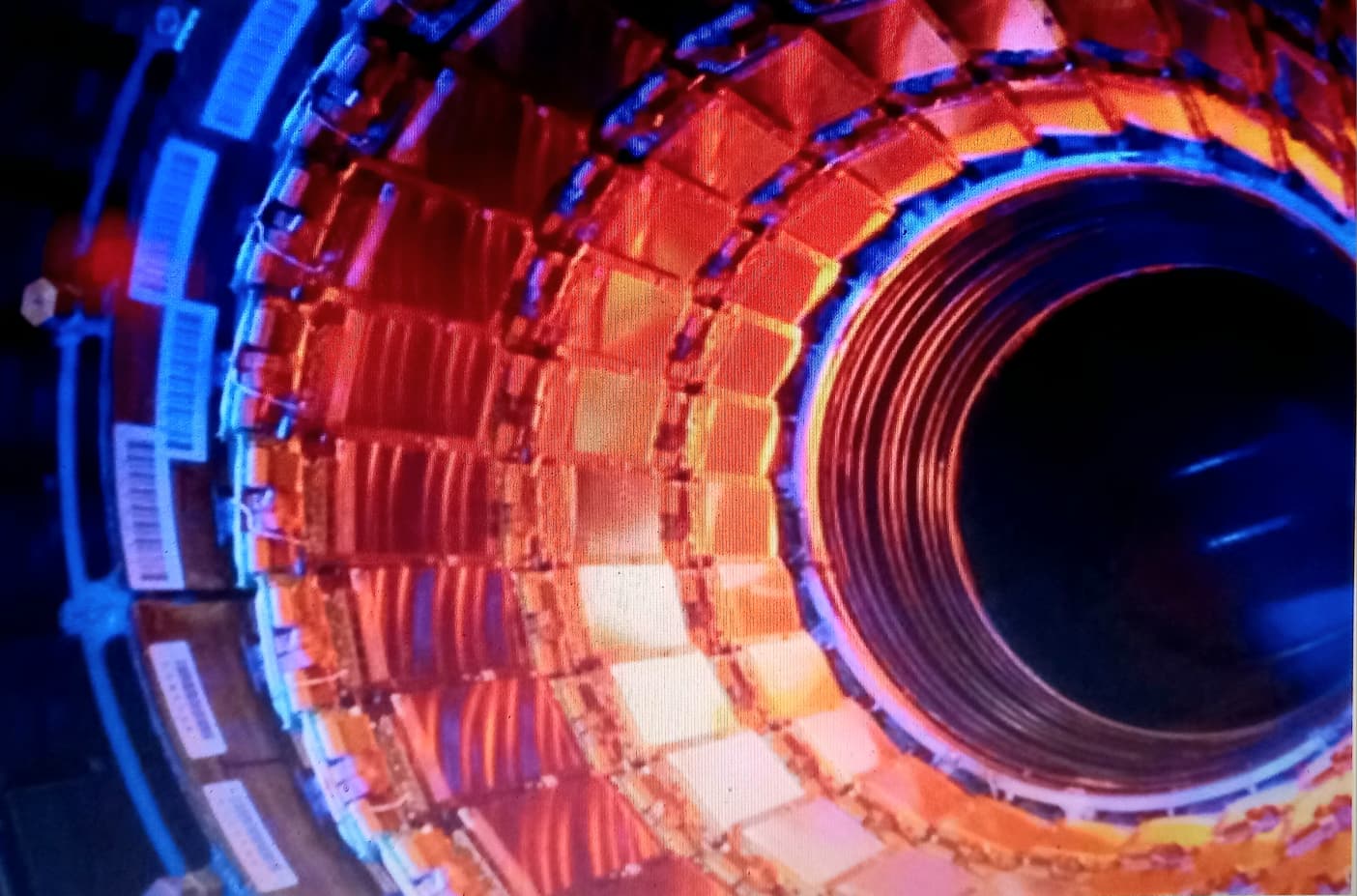
Toponium is a, short-lived “quasi-bound” state consisting of a top quark and a top antiquark (𝑡𝑡̄), acting as the heaviest and smallest possible meson (~10−17 meters). Recent (2025) data from CERN’s CMS and ATLAS experiments show a ∼341 GeV/𝑐2 threshold excess, suggesting this particle forms despite the top quark’s extremely short lifetime (∼5×10⁻²⁵ s).
This finding provides insights into quantum chromodynamics (QCD) and the behaviour of the heaviest known fundamental particle, the top quark. The result, confirmed by ATLAS, is viewed as a major, unexpected observation in particle physics.
The ATLAS experiment managed to observe this phenomenon, giving clear evidence of its existence for the first time. According to the Spanish National Research Council (CSIC), this result not only validates theories from three decades ago, but also shows that there are still quantum states to be discovered within the limits of the Standard Model.
Thanks for Reading
#peace
 Dying to Live