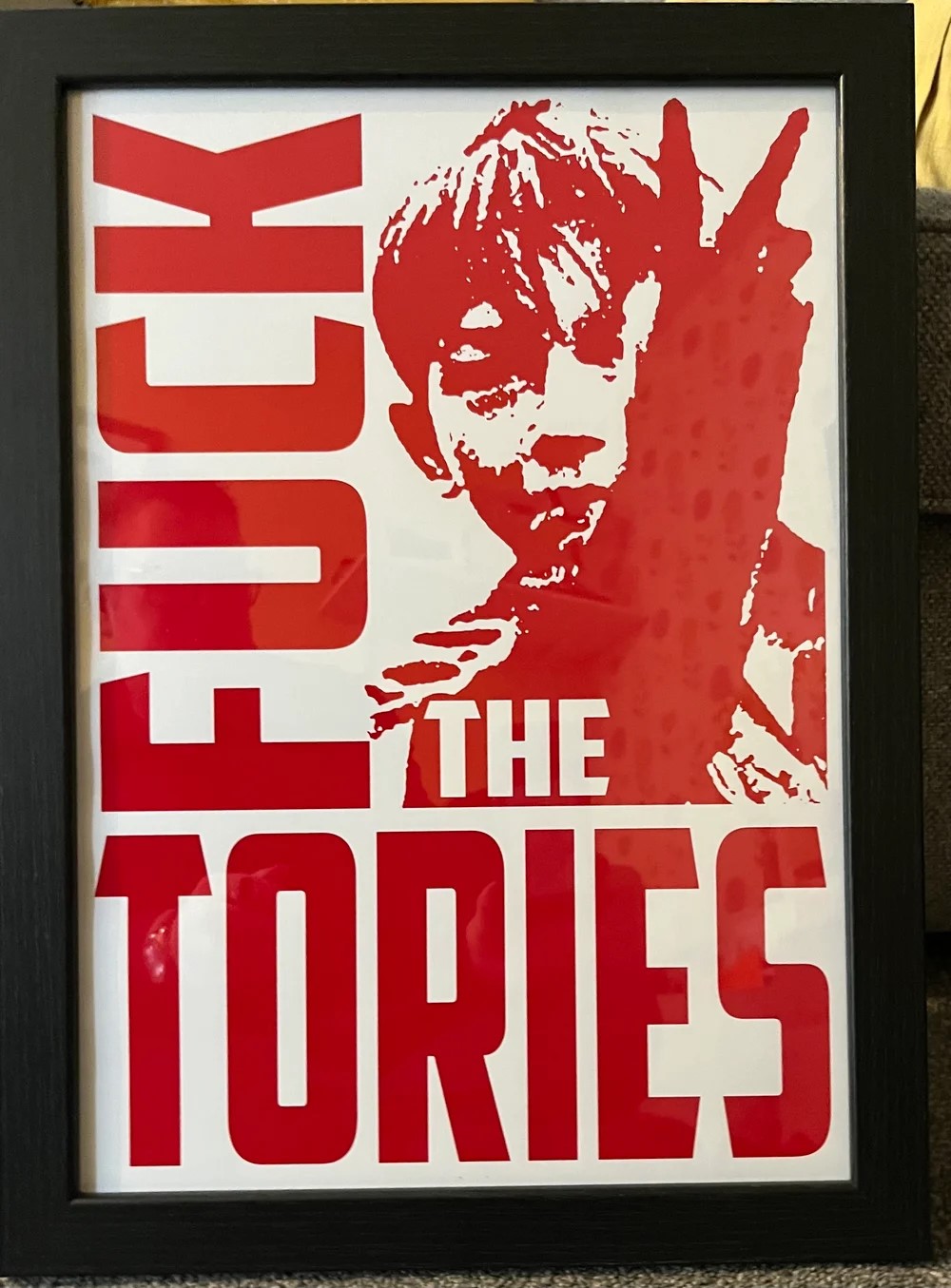
Life – Terror. Ecstasy. Fight. Denial. Flight. Failure. PAIN. Forgiveness. Reconciliation. Hope. Love. Peace – Death
22nd May 2024 Rishi Sunak declared a General Election on the 4th July 2024.
In little more than six weeks the country will go to the polls.
A surprise decision [for most], sparking a tsunami of social media opinions, ‘Wont be any better under Labour’, ‘Be worse, open borders and even more tax to pay for the dinghy people’, ‘Starmer is a Tory [Torie] anyway’. ‘They [Labour] will be worse’.
Even the most blinked of Conservative MPs seem to agree; our public services are overwhelmed. Public trust in politics is shot. The country is in a mess. Our economy is [at best] stuck. As the background music to Sunak’s live election announcement, D-REAM, ‘Things Can Only Get Better,’ confirmed, it’s impossible to argue that things are going well.
Personally?
I cannot declare a single positive from the past 14 years of Torie governance. I can, however, see a mountain of negatives. For all Torie voters now and previous, Lest ‘you’ Forget, when you hit the polling stations on July 4th I remind you of the previous 14 years of Torie governance, especially the past seven years that have looked horribly like a spiral that we would never break out of.
The risk is that if conventional politics is seen to have failed completely, voters become more willing to try out extremists—a worrying, growing trend, the rise of the right. A pattern that is not confined to the UK.
Conservatives will, no doubt, keep searching for someone else to blame. But, during one of the more challenging periods in our history, we have been saddled with our worst-ever government. I cling to the hope they will NEVER be forgiven.
A reminder
Immigration. The Tories number one BREXIT Election Campaign driver. Despite multiple pledges to reduce net incomers to the tens of thousands, the Tories have failed to take necessary steps to achieve it. Immigration is higher than ever, and now more driven by low-skill, low-wage migrants from outside of Europe.
The party has failed to either articulate an economic argument for liberal, free-market immigration or impose control over it. It has repeatedly said one thing and done another – a record of tough rhetoric and no action.
Increased poverty, higher prices and shrinkflation, homelessness, reduction in public services and deteriorating quality of roads, parks, libraries, the shortage in nursing and school staff, frightening levels of inequality [that they don’t understand because it doesn’t affect them], increased levels of racial abuse, failure to reform the police, an 8 million NHS waiting list, wastage of public funds, shameful self gratification, reduced funding for HMRC leading to colossal public [and personal] normalisation of corporate tax avoidance, normalisation of Foodbanks, persecution of LGBT (especially trans) people, and the big one for me – BREXIT, an unmitigating disaster.
There are dozens specific carastrophies and key protagonists, Johnson, May, Truss, Hancock ….to name but a few? But, from the point of view of political disasters, sheer governmental incompetence, [the main reason we should not re-elect them], they made three disastrous, monumental calls.
First, to reduce the deficit harder and faster than other countries, despite the precarious state of the economy.
Second, to facilitate the vast bulk of deficit reduction (80 per cent) from spending cuts rather than tax increases.
Third, to concentrate these cuts on benefits and services used by groups with little political voice, while (largely) protecting those parts of the state, like health and education, that most of us come into contact with. In doing so they had the support of most of the media and, at the time, the majority of the public too.
The net result was that large chunks of the state that don’t make the [mainstream] news often enough were absolutely hammered. Departments like the Ministry of Justice saw spending cuts of over 25 per cent at their peak and the Home Office saw cuts of 20 per cent.
Worst hit was local government, with massive reductions in government grants, only partially compensated for by tightly controlled increases in council tax. Councils’ average spending power fell by almost 30 per cent and considerably more in the labour controlled authorities with the poorest households. Intense pressure on statutory duties like social care, with an ageing population, and special educational needs, with huge unmet demand, reduced the scope for discretionary spending by councils even more.
The very poorest were hit hardest
Osborne and his Liberal Democrat colleagues did make some attempt to spread the pain around. Wealthier families saw their child benefit removed and higher marginal tax rates. Lower earners in work were helped by a higher minimum wage. But those reliant on benefits saw their income literally drop away.
Increasingly, the welfare state became more detached from assessments of need. And the pain only got worse after the Conservatives took sole power in 2015. Osborne proceeded to implement his harshest round of benefits cuts yet, leading to welfare secretary Iain Duncan Smith’s resignation.
Departmental cuts stopped in 2017, after Theresa May’s disastrous election campaign—remembered for her woodenness and the so-called “dementia tax”—confirmed that austerity was no longer popular.
Budgets for all departments have been flat or slowly rising since then. But not benefits. They have continued to be squeezed, bar a brief boost during the pandemic. Housing benefits have fallen to the point that barely any properties are affordable. The benefits cap, which limits the amount any household can receive, was set at average income in 2013 but has hardly ever been increased since then.
As inflation has hit, more and more families—especially with multiple children—have been affected. The “two-child limit”, implemented in 2017, which stops benefits being paid from the third child onwards, added to the misery.
At first this [austerity focused at the least well off] strategy was successful, politically at least, leading to the surprise Conservative majority of 2015. The most widely used services were still functioning well. The people most affected were not Conservative voters—indeed were much less likely to vote at all. Osborne’s master plan was working.
For those paying attention, though, the warning lights were starting to flick on. The decision to focus cuts on marginal populations had meant the worst effects were hidden to most [voters]. But those effects were causing real problems.
Trussell Trust food banks, which barely existed in 2010, were distributing one million food parcels a year by 2014–15 (it’s now three million). Increasing numbers of households were living in overcrowded accommodation. Numbers living in “relative poverty” on the government’s measure stayed fairly stable, due to higher wages for lower paid people in work, but that masked the descent of the very poorest into deep poverty. A Joseph Rowntree Foundation report from October 2023 found there were now over one million children living in destitution—that is, living without proper shelter or without enough food.
Meanwhile the departments that had absorbed the biggest cuts were struggling badly. The prison system was one example. Turnover of prison officers increased as pay was frozen, there weren’t enough staff to provide proper support to prisoners, conditions worsened and drug abuse and self-harm among prisoners rose dramatically.
Overcrowding increased as prisons got ever fuller with little money invested in new accommodation. In 2023 we finally hit the point where there was no space left at all and prisoners had to be released early, a practice that is being repeated again, this week, as we speak….from the party of ‘Law & Order’.
The immigration system started to fall apart as underpaid caseworkers left the Home Office and the backlog of cases rose, well before the small boat channel smugglers even got going and the right of the Conservative party developed its now all-consuming obsession with Rwanda. Local councils cut discretionary programmes such as SureStart, parenting classes and youth provision, which weren’t a legal requirement but nevertheless were a lifeline for many families.
There was only so long the social problems caused by this concentration of austerity on the most vulnerable could be hidden. Even before the pandemic it was becoming clear that austerity was having a detrimental effect on the services that ordinary voters—Conservative voters—relied on.
Police numbers became a big issue during the 2017 campaign, due to a number of high–profile terrorist attacks. But one of the main reasons the police were struggling was because they were dealing with the consequences of that concentration of austerity. For instance, domestic abuse cases went up as families came under more stress, and by 2022 these cases accounted for almost a fifth of recorded crime.
Police have also had to deal with a rise in mental health disorders, which correlate closely with poverty. Between 2019 and 2022 alone the number of mental health incidents they had to attend rose 20 per cent. As the Chief Inspector of Constabulary has written: “In blunt terms, too much police time is still being spent performing the work of other public services. This is because many public services are under financial pressure and can’t meet their own demand.” Partly as a result of this, crimes experienced by ordinary voters are now much less likely to be charged.
Schools are suffering from having to do the work of other services. Exam results are one of the few things that haven’t got worse over the last decade, and there is even some evidence of improvement relative to other countries in comparative international tests.
But these positives are at risk due to schools having to cover for other services—75 per cent of our schools now provide some form of food bank or parcel service for children or their parents. They are also having to manage more safeguarding cases, with 24 per cent more children in care in 2022 than in 2012. Pastoral care has become a big drain on teacher time and a major cause, alongside lower pay, of a crisis in teacher recruitment. This year, only half the target number of secondary teachers started training.
Of course the problems caused by the concentrated hit on the most in need have been exacerbated by appalling governance, particularly since the Brexit referendum set off a period of turmoil that saw us run through five prime ministers.
There have been seven education secretaries since 2019 alone. There is no way the public sector can be managed well in such circumstances, especially as all the various cabinet combinations have prioritised loyalty over competence.
The Covid inquiry has revealed in gory detail quite how incapable of basic management or decision-making Boris Johnson’s regime was. Add in a global pandemic and you have a perfect storm.
What’s happened to the NHS is the most vivid [disastrous] case study. Before the pandemic performance was already starting to deteriorate, with waiting lists and A&E wait times rising. While budgets had been maintained they had not risen in line with need. Money for non-urgent budget lines like preventative healthcare, buying new equipment, and building repairs, were squeezed to cope with day-to-day costs during increasingly acute winter crises.
A stream of health ministers had different priorities for reform, engaging in multiple incoherent restructures and sucking up more precious time and resource. Cuts to the number of beds continued despite it becoming apparent that hospitals were dangerously full, and care homes were struggling to provide enough beds for older patients who needed to be discharged.
When the pandemic hit, the health service quickly became overwhelmed. There was simply no capacity to deal with the waiting lists that built up while medical staff were focusing on Covid patients. Ministers’ stubborn refusal to negotiate with doctors taking industrial action for almost a year, until starting talks in October 2023, has caused waiting lists to rise even further, to historic highs approaching eight million.
Because hospitals are so full there is nowhere to send those attending A&E departments, leading to chaos and 10 per cent of patients waiting more than 12 hours for help. In 2009-10, less than 350,000 people had to wait more than four hours to be seen. In 2022-23, that number was over six million. All the while medical staff are also having to deal with the consequences of rising poverty, poor-quality housing, and growing numbers suffering from mental health problems.
It’s all so bleak that it’s hard to identify any successes? Ironically, where there have been achievements they tend to run counter to the populist rhetoric that the Tories are employing to keep their fracturing 2019 voter base on board. Gay marriage is the one thing from the Cameron era that almost everyone now applauds—although it was opposed by a narrow majority of his own MPs at the time.
Renewables have become a much bigger part of our energy market, in part down to innovative public policy. Furlough, and the universal credit uplift during Covid, briefly restored some of the welfare safety net, only for it to be taken away again.
Skilled immigration has increased since Brexit, bringing in some of the world’s smartest people from outside the EU. But added together it’s a meagre legacy.
Which does raise the question as to what the current government is going to hold up as achievements during the impending election. Ministers will, of course, try to raise fears about Labour, but voters who share some of those concerns [with little confidence in Starmer] may be thinking: “What have we got to lose?”
If Labour does find itself in power, as looks very likely, its inheritance will be the worst of any government since the 1970s. Every aspect of that gamble Cameron, Osborne and Clegg took in 2010 has failed. It is perhaps appropriate that Cameron is back in government as foreign secretary to witness the consequences of his errors.
The Tories seem resigned to their inevitable failure and are therefore intent on making things as difficult as possible for their successors, ‘Scorched Earth’. Debt is higher than at any point since the 1960s, and much more so than when we were told there was no alternative to hard and deep cuts. Throughout the 2010s, interest rates were very low and borrowing was cheap, yet the public realm was allowed to deteriorate.
Borrowing now to repair the damage would be far more expensive, but cannot be delayed much longer. There is a £22bn maintenance backlog in education and health alone. The initial decision to focus on reducing the deficit through cuts rather than tax increases was made with the interests of Torie voters in mind. But as budgets have had to start rising again since 2017 the tax burden has been forced up regardless, to its highest level since the war, with millions more people paying higher-rate income tax.
Labour will also inherit the £10 Billion compensation to be paid to victims of the poison blood scandal. They will be caught between higher borrowing costs, a strong desire to avoid significant further tax rises and -collapsing public services. Economic growth is the only sustainable way out, but current projections suggest ongoing stagnation.
There are certainly things that can be done to improve the picture, from making it easier to build houses to rejoining the EU single market. But none of these things will happen quickly, and all are beset with political difficulties. There will need to be some investment in infrastructure but, again, the state of our public finances will limit what can be done.
Everywhere you look there is a crisis: the NHS, the entire criminal justice system, housing, social care, higher education and on and on. Almost all NHS trusts are in deficit. Several councils have already fallen into effective bankruptcy—including the biggest, Birmingham—and 26 others are at risk, with some of the larger Torie shires on the list. There is a recruitment crisis across most of the public sector, as lower pay and the sheer emotional exhaustion, exacerbated by huge demand and a crushing sense of failure, have made it harder to persuade people to sign up. It is worst in social care, where there are over 150,000 vacancies, more than the total number of doctors in the NHS.
All these problems feed off each other. The initial focusing of austerity on the poorest increased pressure on public services, helping to trigger crises. These crises have their own knock-on effects. For instance the inability to get adequate healthcare has pushed up the numbers out of work for health reasons, and the numbers on disability benefits which in turn has created a tight labour market, even in a stagnant economy, which has made growth even harder to achieve and public sector recruitment more difficult too. That lack of growth reduces the scope to invest in public services.
Labour [or the Conservatives should they by some miracle be re-elected] have a more or less impossible job but DO NOT forget it is the Tories who have put us in this situation. The Tories have failed to fulfil the mandate they arrived with, to build Britain back from the global financial crisis. Since then, the economy has stagnated with more than a decade of sluggish growth. Wages have been frozen in real terms. House prices have escalated in many parts of the country, leaving the young adrift. At the same time, public services have decayed from austerity, becoming more stretched rather than the much-promised efficiencies.
Do not give them another chance
Thanks for reading
#peace
#fuckthetories #fuckcapitalism
 Dying to Live