Life – Terror. Ecstasy. Fight. Denial. Flight. Failure. PAIN. Forgiveness. Reconciliation. Hope. Love. Peace – Death.
Are there food banks in China?
The concept of food banking was born in the United States in the 1960s.
The only food bank in China certified by the World Food Bank, Oasis Charity has practiced a very straightforward idea for several years: let more food be eaten than wasted. A logical system within a government controlled supply/demand/profit economy or a simple choice not influenced by ‘ever increasing profit’? It might be argued this is not as simple to implement within a fully, free market (UK) economy? Where ALL supermarkets have full control over there ‘businesses’ and are completely [share holder] profit driven. Many would [and do] prefer to throw good food away rather than re-distribute to hungry people.
How many food banks are there in the UK?
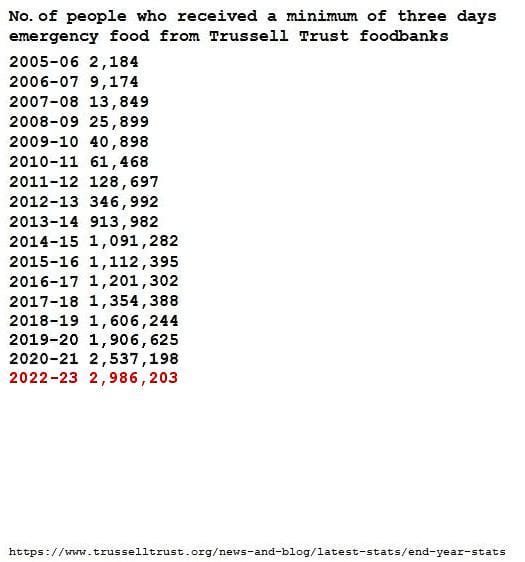
There were 1,400 Trussell Trust food banks in the UK, in addition to 1,172 independent food banks, 2,572 Foodbanks in the UK in 2023. 2024, this has risen by at least 30% to 3572. In 2010 when the Tories took power there were 35! Foodbanks are not exclusive to the UK.
The French food bank’s ethos is “L’aide alimentaire, porte d’entrée vers l’inclusion” which translates to “Food aid, a gateway to inclusion” Established in 1984 in Paris, the food banks were founded on principles that still govern the daily life of the 79 Food Banks and 29 branches.
2.4 million French people were benefiting from food aid at the end of 2022 – three times more than a decade ago – a study released this week found. More than a third of the beneficiaries are newcomers, a phenomenon tied to the sharp increase in inflation over the past six months. Food insecurity among students was not uncommon before the pandemic. But the problem has ballooned post pandemic (due to lockdowns).
Aid organizations that mainly fed refugees, the homeless and people below the poverty line have refocused operations to also meet a surge in demand among youths. At the Restos du Coeur, one of France’s largest food banks, with 1,900 outlets, the number of adults under 25 lining up for meals has risen to become nearly 40 percent of the total.
Over eight million people in France visited a food bank last year, compared with 5.5 million in 2019. Food aid demand across Europe has surged by 30 percent, according to the European Food Banks Federation.
The Belgian Federation of Food Banks is a coordinating organization that represents a national network of 9 regional Food Banks. In their fight against hunger, the Food Banks, through 676 affiliated local organizations and thousands of volunteers, provide free healthy and varied food to people in need.
The number of people in the Netherlands turning to food banks for help rose 7.2% last year, the national organisation said on Wednesday. The Netherlands has 171 food banks nationwide, which helped 160,500 people with free groceries last year. The biggest increase in clients was in Noord-Holland province and Rotterdam, and the organisation expects a further increase in 2021. The government supported food banks to the tune of €4m last year, a donation which it made because of the expected surge in demand due to coronavirus. However, most of the cash has so far not been used — because food banks rely on donations from shops and restaurants.
Unlike the UK, there is a national food-bank organisation in Germany, known as the Tafel – the German word for table. It runs more than 940 individual “food banks” in the network – but many operate more than one distribution centre. This is the highest figure to date in the country.
In Sweden, there is a private initiative that has functions like a food bank (Allwin), but not the status a national food bank. ICA works with charity organisations in all its markets to donate food in various ways.
ICA Sweden has a central agreement with the Salvation Army and several local partnerships with charities to donate food from ICA’s warehouses that cannot be sold in stores because it is short-dated or has damaged packaging, even though the food itself is fully edible.
Italy – Since 1989 the Fondazione Banco Alimentare Onlus has been collecting the production surplus of the food supply chain, and by means of its network of 21 organizations spread all over the country, it has been redistributing it to over 8.898 charitable organizations that assist the poor and the needy all over Italy.
The Banco Alimentare Network collects foodstuffs which are still perfectly edible but, having lost their commercial value, would be destined for destruction. These foodstuffs are saved from waste, recover their value and become a richness for those who have too little. The main supplying sources of the Banco Alimentare Network are the food industry, organized large-scale retail trade, and collective catering service. Besides, a relevant amount of food products are granted by European Union within a specific programme of helping the poor.
The Food Bank Network works 365 days a year – In a typical year, they are donated
– 42.000 tons from the European Union
– 12.125 tons from the food industry
– 3.221 tons of fruit and vegetables
– 5.171 tons from distribution
– 309 tons from catering service.
In addition, they collect 9.828 tons of food from private donations
Besides the daily activity of recovering food surplus and distributing it to the poorest in our country, every year on the last Saturday of November the Fondazione Banco Alimentare organizes the National Food Collection Day. Since 1997 this appointment has become an important moment, involving civil society and raising awareness about the problem of food poverty thanks to concrete and free gesture of sharing: to buy food for those who need it. During this day, a large network of supermarkets is involved in the whole country. Everyone can give a part of his shopping in order to answer the need of those who live in poverty.
Madrid, 17th December 2020. Throughout 2020, DIA has distributed 2.5 million kilos of products between 54 Spanish Food Banks, in order to feed the households of the most vulnerable families and fulfil its goal of being closer to society every day. In doing this, the company has doubled its donations compared to the year before
The figure includes deliveries from the DIA warehouses (more than 500,000 kilos), the Great Food Collection (2 million kilos) and the “DIA Contributes 2020” programme which the company set up in April to try to mitigate the negative effects of the pandemic on the vulnerable population, in the form of several virtual collections on its online store Dia.es (56,800 kilos), one-off donations (18,000 kilos) and “Kilo Operations” in stores (more than 1,200 kilos).
The Food Bank of Madrid is a non-profit charity organization whose purpose is to collect free food to distribute it, also free of charge, among charities dedicated to the assistance and direct care of people in need within the Community of Madrid.
The Food Bank is a member of the Spanish Federation of Food Banks (FESBAL) , which currently groups 54 Food Banks from all over Spain, and through it to the European Federation of Food Banks (FEBA) , which includes 271 Food Banks across Europe.
Founded on September 1st, 1994, the Food Bank of Madrid was registered and approved on September 15th, 1994 by the Government Delegation of Madrid, with Provincial Registry number 14,713, and registered in the Registry of Social Action Entities and Social Services of the Community of Madrid with the number E 1318.
It was registered in the Registry of Foundations of the Community of Madrid with personal sheet number 237 in volume XXVII, sheets 101 to 116, dated September 12th, 2000, and CIF (Fiscal identification code) G-82698614.
Portugal – The Food Bank was created in Portugal in 1991. Currently, there are 21 Food Banks in the areas of Abrantes, Algarve, Aveiro, Beja, Braga, Castelo Branco, Coimbra, Cova da Beira, Évora, Leiria-Fátima, Lisbon, Madeira, Zona West, Portalegre, Porto, São Miguel, Santarém, Setúbal, Terceira, Viana do Castelo and Viseu. 150,000 families have no money for food: Food Bank boss says: “I’ve never seen this level of brutality.
Over 150,000 families — comprising around 600,000 people — have been forced to the point where they are now appealing to charitable organisations for food. Say sources at Caritas (Catholic church charity), the Banco Alimentar Contra Fome (Food Bank against Hunger) and other institutions, desperate requests for help have snowballed during the weeks in Portugal
One in every 10 families has seen at least one earner lose his/ her income, with 4% of households seeing two earners lose their income (which in most cases is the only form of sustenance within the family group).
USA – The Feeding America network 200 food banks and over 60,000 faith-based and charitable agency partners, including food pantries and meal programs, helps ensure people facing hunger can put food on the table.
The Global Foodbanking Network (GFN) reports that its 943 members across Europe, Africa, the Middle East and Southeast Asia served 9.6 million people in 2018, a 23-per-cent increase on the previous year.
Warshawsky reports that food banks now exist in 80 countries worldwide.
Campaign to overcome shame
Unfortunately, the number of people who are unable to buy enough food and who are regularly hungry is much larger than the groups that food banks are currently helping. Shame is still the most frequently cited reason for not knocking on the door for food aid. That is why, for example, Food Banks in the Netherlands are working hard on the ‘Nothing to be ashamed. More countries need to follow and de-stigmatise foodbank use otherwise people (children) do starve.
Is any of this ok?
Is it too much to expect that our incomes our taxes our economies ‘are’ enough to put roofs over our heads and food on our tables?
Apparently not? So, where are our Yellow Vests?
Where are our protests and where are our MP’s working on our behalf to solve this?
Silly question, they are all eating 7 star FREE food in the Houses of parliament.
#ShitholeUK
Thanks for Reading
#Peace
 Dying to Live