Life – Terror. Ecstasy. Fight. Denial. Flight. Failure. PAIN. Forgiveness. Reconciliation. Hope. Love. Peace – Death.
The Great North – South Divide
In Great Britain, the term North–South divide refers to the economic, cultural and political differences between Southern England and Northern England, or sometimes between southern England and the rest of Great Britain including the Midlands of England, Wales and Scotland.
The stereotype portrays northerners as being more outgoing, forthright and gregarious; southerners as being more wary, noncommittal and reserved. To many Southerners, ‘we‘ in t’north all still wear wooden clogs & live off bread and dripping. Most southerners I have encountered regard themselves as more intelligent, more savvy and more cultured than ‘most’ Northerners.
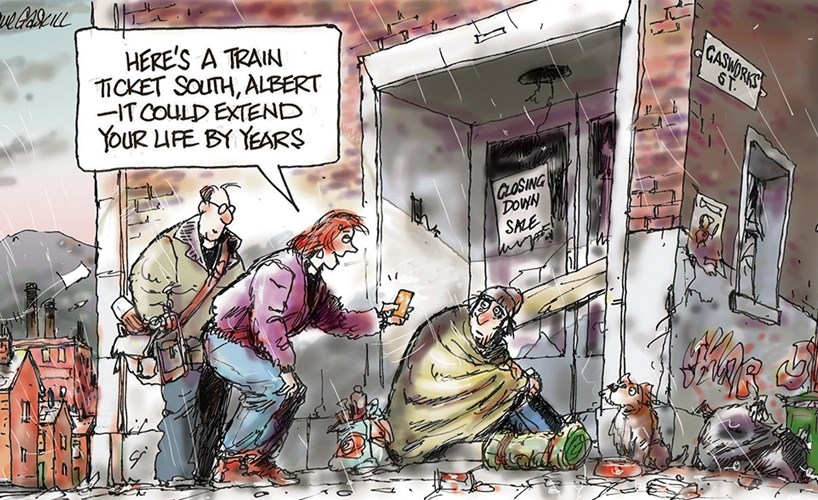
People in northern England are far more likely to live unhealthy lives when compared to those who live in the south, the first official national ‘health index’ has shown.
In the study, which has been compiled by the Office for National Statistics and financial services company Lane Clark & Peacock, the top ten healthiest places are all in the south east apart from Rutland, which is in the east midlands.
The unhealthiest places on the other hand are mostly in the north west and north east, with just two – Stoke-on-Trent and Nottingham – in the midlands.
The main cause of the north-south divide is de-industrialisation, as manufacturing industries, traditionally located in the north closed. Manufacturing continues to be very important in the north whereas in the south it is ranked 7th.
The Nations Capital, London
Theirs is significant history behind London’s North-South divide, but basically, it’s all about money. If you’ve ever walked alongside the Thames in the heart of London, you probably noticed that the most important and wealthy buildings all lay on the same side of the river: the North.
After the Romans left in the early 400s, The British Isles were divided into a large number of minor kingdoms, tribal regions and so on. Over the next 800 years or so (circa 1200), these were coalesced into England, Ireland, Scotland and Wales, but these were not yet united.
Since 1922 the United Kingdom has been made up of four countries: England, Scotland, Wales (which collectively make up Great Britain) and Northern Ireland (variously described as a country, province, jurisdiction or region).
It is clear that since the Norman period, the foundations of a North-South Divide have been evident in the UK. Poverty characterised the North and wealth, the South. Fast forward to the Industrial Revolution of the nineteenth century and these political and regional divisions deepened.
In 1962, Prime Minister Harold Wilson’s Home Secretary, Henry Brooke, voiced his fears of ‘two nations developing geographically’. The industry largely took place in the North and London in the South became of increasing importance as a financial centre. However, the idea of a polarised North and South truly came into public consciousness during Margaret Thatcher’s period as Prime Minister.
Chancellor Willy Brandt
The Brandt Line is a visual depiction of the north–south divide, proposed by West German former Chancellor Willy Brandt in the 1980s in the report titled North-South: A Programme for Survival which was later known as the Brandt Report.
The entrenching and worsening of existing divisions between the North and the South came under the leadership of Conservative Prime Minister Margaret Thatcher in the 1980s. Some historians have cast Thatcher as a hero, dubbed ‘The Iron Lady’ by the Soviet press, who helped end the Cold War and revived the turbulent economy of the 1970s.
Alternatively, some of her politics still bring contempt from the working-class people whose lives they directly affected. Let’s see how some of them increased the inequality between the North and the South.
Another policy that Thatcher introduced to help stimulate the economy was privatisation. This refers to the redistribution of state-owned companies to privately owned ones. It also tied in with her early monetarism policy.
Monetarism
Monetarism is the idea that the money supply can control inflation. In theory, higher spending would control inflation. Increasing interest rates and lowering taxes and spending were the main tactics the government used to do this.
By the end of Thatcher’s term, 40 government-ran businesses and more than half a million government-employed workers had been privatised. This included giants such as British Telecommunications and British Gas.
Thatcher favoured the individual over centralised services. For many communities in the North that struggled to cope with deindustrialisation, the state-offered services were a lifeline. Thatcher moved swiftly to cut this sector, for what they perceived as private greed and left levels of unemployment at over 11% in 1985
The North-South Divide became a metaphor for those who are fortunate and unfortunate with London representing the South, but now we are seeing that London votes Labour. There is also a drive for the redistribution of some services in the UK, departing from London or the South, with the BBC recently moving its headquarters to Manchester.
The Global North-South Divide
The Divide and Rule policy is a strategy that was used by the British during colonial rule in India. This policy was used to keep the Indians divided so that they would be easier to control. The British used this policy to create divisions among the different religious groups, castes, and ethnicities.
While the Global North implies the developed economies, the Global South implies the underdeveloped economies. Four broad indicators distinguish global north economies from global south economies. These include politics, technology, wealth and demography.
The North-South Divide is criticized for being a way of segregating people along economic lines and is seen as a factor of the widening gap between developed and developing economies.
How might HS2 reduce the UK North South divide?
Those for say that HS2 will also play a crucial role delivering Northern Powerhouse Rail – the backbone for an integrated northern rail network. Together these better connections will help to level-up the country.
It is proposed it will eventually create a Y-shaped network, connecting Birmingham, Manchester, Liverpool, Leeds, Sheffield and the East Midlands – and linking them all to London.
Organisations that support the HS2 project include: The three major UK political parties: Conservative, Labour (albeit with some criticism of the proposed route) and the Liberal Democrats.
Who opposed HS2 and why?
The Woodland Trust opposes the current route of the proposed High Speed 2 rail link because of its impact on ancient woodland. It reports that 108 ancient woods are threatened with loss or damage from the project.
Will HS2 go ahead?
A branch connecting HS2 to the West Coast Main Line near Wigan was axed in June last year, saving up to another £3 billion. A budget of £55.7 billion for the whole project was set in 2015. But the target cost has ballooned to up to £71 billion, excluding the eastern leg axed in 2021.
Will we (the North & South) ever be ‘united’?
We are all essentially “valence voters”, who will generally go for politicians who, in some nebulous way, we feel to be like us. When George Orwell went north researching The Road to Wigan Pier, he found that the yawning class divide between him (an old Etonian) and a sharp-nosed, dark-haired little cockney melted away in face of the cultural otherness of the northerners: “He suddenly divined that I was a fellow-southerner. ‘The filthy bloody bastards!’ he said, feelingly.”
That was why Peter Mandelson, in 1994, confident that he could rely on a desperate north to back almost anyone, saw that Tony Blair’s vague “southern appeal” was so vital.
Keir Starmer (southern accent, Knight of the Bath, QC) is well placed to repeat that trick, but can anyone ever really appeal for long to both north and south in England? (Blair himself, lest we forget, was under heavy fire from the north by 1999.) Johnson thought he had cracked it, but that now seems risible.
It may be time to recognise what voting maps show quite clearly: the English have always voted as much on tribal lines as any of the Celts. “We” are not a single people at all and never really have been. Or we can insist, against all the historical evidence, that we are one nation, a nation that, as Churchill saw in 1912, will almost always be ruled by the party of the south.
Are you North or South?
In terms of the healthiest places, as well as Wokingham, the Greater London area of Richmond-upon-Thames comes second in the list followed by Windsor and Maidenhead, West Berkshire and Surrey.
Other areas in the top ten most unhealthy places as well as Blackpool and Doncaster include Hull, Stoke, Middlesbrough and Hartlepool.
The analysis throws into high relief the scale of the much-vaunted ‘levelling up’ agenda Tory Government has set itself.
Thanks for Reading
Peace
 Dying to Live